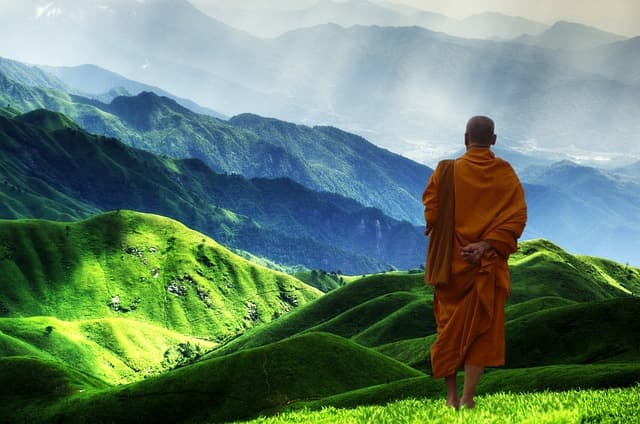
Despite the large number of films about Tibet (“Samsara,” “Milarepa,” “Kundun,” etc.) “Seven Years in Tibet” remains the best-known and most popular feature film about the country. This is largely due to the outstanding director Jean-Jacques Annaud (author of “The Name of the Rose” and “Enemy at the Gates”) and the charismatic Brad Pitt in the lead role. On the other hand, the movie turned out to be very beautiful and spectacular. The whole entourage: Tibetan mountains, Potala Palace, Jokang Temple, old Lhasa – are recreated with amazing authenticity. You get the impression that the shooting took place in Tibet (actually in Argentina), and the buildings of old Lhasa are not sets, but real Tibetan architecture.
The story is based on an autobiographical book by Heinrich Harrer, a famous Austrian mountaineer and traveler. Many believe that Harrer’s book is more interesting than the movie, but the film adaptation carefully preserves the main line of the story: World War II, two prisoners of war escape from the British camp in India to reach the Japanese front in China. To do so, they have to cross the Himalayas and Tibet. After much wandering, they reach the forbidden Lhasa, where they become guests of the nobility and family of the young Dalai Lama. Harrer even becomes the mentor of the “God-King.” However, after the Chinese invade, he has to leave the country that has become his second homeland.
How is the movie different from the book?
In the movie it seems that the journey from India to Lhasa takes the characters a few months, but in reality Harrer and Aufschneiter wandered around Tibet for about a year and a half. A third of the book is devoted to describing these wanderings, and this is its most fascinating part. Their journey on foot through the inaccessible areas of Tibet even today seems impossible. The Indian border with China is now closed, but back then they crossed it near Mount Kamet and reached Tsaparang, skirting Kailas and Lake Manasarovar before heading south again to the Himalayas.
Some of the book’s details are questionable: Harrer confuses lakes, and the religious descriptions are not always accurate. For example, Chenrezig (Avalokiteshvara) is a bodhisattva, not a “reincarnation of a god.”
The movie shows Harrer’s spiritual rebirth, but in the book his character and views do not change so clearly, although the experience of living in an isolated country certainly affected him. In addition, Harrer was not the egoist that the movie portrays him to be. In the spirit of Hollywood, the movie pays a lot of attention to the hero’s personal life and his romantic relationships. In fact, by the beginning of the expedition Harrer was already divorced, and the love triangle – fiction screenwriters. In the book, the mores of Lhasa are described simply and without exoticism: “Sometimes a pretty maid can spend the night with you, but usually Tibetans do not give without courtship.
Harrer was not looking for a mythical Shambhala in Tibet. He describes the country objectively: poverty, disease, early mortality, political upheavals and wars, but also a remarkable religiosity and culture, which he contrasts with Western civilization: “What could Europe oppose to the true politeness of the Tibetans? No one was humiliated here, aggressiveness simply did not exist.”
Some scenes in the movie are exaggerated. For example, the episode with worms, which takes one line in the book, is turned into a five-minute scene in the movie. There are also mistakes: the Chinese general arrives in Lhasa by airplane, although the first runway appeared there only in 1956.
After the release of the movie, Brad Pitt, Jean-Jacques Annaud and David Thewlis were banned from entering China, although the director did visit the Celestial Empire in 2012.
Is the movie worth watching?
Absolutely, yes. Not only is the movie beautiful and exciting, but it will also be a great introduction to the history of Tibet for those who don’t know much about it. For people far removed from Buddhism and spiritual pursuits, it may help them understand why so many people seek and find inspiration in Tibetan culture.