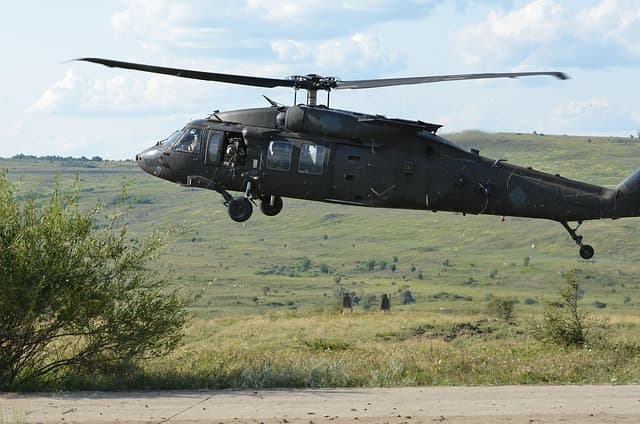
“The Fall of the Black Hawk ”In 2001, another American blockbuster called “The Fall of the Black Hawk” was released in movie theaters. In the movie, heroic American soldiers from the special unit “Delta” and the group “Ranger” are ordered to capture two key supporters of Mohammed Farah Aidid. In the movie’s script, Mohammed Farah Aidid and his supporters are accused of an illegal coup, power grab, and genocide of the people of Somalia (the power grab in Ukraine in early 2014 immediately comes to mind). One group flies in helicopters, the other moves in convoy in jeeps. The goal of the operation is to quickly get to a building in the center of the city, capture the leaders of the Aidida group and rush to the base. But something goes wrong, the terrorists grab for weapons, and the massacre begins. And of course, heroic American guys heroically save their own soldiers, caught in the mess. Well, so on and so forth.
Many years ago I watched this movie, I must admit, somewhere even cried. But recently I came across an article about the motives of this movie.
This movie is set in 1993 at the time of Operation Restore Hope. In 1992, the UN Security Council established the UNOSOM I mission to deliver humanitarian aid to people suffering from the civil war in Somalia. The humanitarian aid delivery operation itself failed for many reasons. Then in December 1992, at the urging of the US, the UN Security Council passed a resolution authorizing UN forces to use force to quell the rebellion and restore order in Somalia. The US and a couple of its allies brought in troops. But something went wrong (I’m having deja vu). Instead of the UN forces in the US faction being received with flowers and bread and salt, one of the leaders of the faction, Mohammed Farah Aidida, unites a number of Somali clans under his flag and starts an outright war against the UN forces and the US in particular. The US Congress then votes to bring additional forces into Somalia to capture Aidida’s group leaders. An additional tactical group of U.S. Army Special Forces troops “Ranger” is introduced into Somalia.
On October 3-4, 1993, CIA agents report that the leaders of Aidid’s group will gather in a building in Mogadishu. Special Forces on 15 helicopters are urgently flown in to capture the leaders. About three minutes after the flight, an evacuation convoy enters the city. Not without mishaps, the capture of the group’s leaders went according to plan. But as soon as it came to the evacuation, people with guns pulled up to the place, and the massacre began. Within ten minutes, two Super-61 and Super-64 helicopters were shot down. A convoy moved to the crash site of the Super-61 helicopter. However, as a result of control errors under sustained fire, the convoy skipped turns several times, lost its orientation completely, and eventually returned to its original point. Up to this point, the convoy had lost about half of its numerical strength, which forced the command to order the evacuation of the convoy, that is, the escape to the base of the U.S. Special Forces.
By nightfall, the crash site of the first Super-61 helicopter was blocked. About 100 soldiers were surrounded under heavy fire from the insurgents. Five MH-60 helicopters were lost during the evacuation attempts. More than half of the personnel were killed and wounded. At 21:00 the command of the special forces group turns to the UN forces for help. At around 2 a.m., the first armored group of UN forces, supported by tanks, made its way to the crash site of the first Super-61 helicopter. The second armored group at about the same time approached the crash site of the Super-64 helicopter, but found no living people there, turned around and started moving back to the base.
The evacuation of the blocked fighters began at about 6am. However, there were not enough places. Some of the soldiers had to move on foot under the cover of armored vehicles. However, heavy fire forced the mechanics to increase the speed of movement, which left some of the soldiers without cover. The soldiers had to walk under fire for about half a mile to the place where the second armored group was waiting for them (this episode is known as the Mogadishu Mile). However, not a single soldier was killed during the march.
The result of this operation: 20 dead and about 100 wounded on the part of the US forces, 300 to 500 on the part of the SNA (Aidid’s rebel army). Two of Aidid’s supporters were detained after all. The U.S. announced the complete evacuation of Americans from Somali territory, withdrawal of troops. The U.S. Secretary of Defense resigned. By March 1994, all Americans had left Somalia.
The reasons for the defeat include: underestimation of enemy forces; deficiencies in the organization of intelligence; shambolic raid tactics; illiterate choice of the area of operation; poor training of the 75th Pdp personnel; small number and insufficient equipment of SAR teams; errors in the coordination of forces and means; weakness of wheeled armored vehicles.
In 2001, American housewives watched in awe as valiant American soldiers smashed bad guys in Somalia and saved themselves. A little later, the movie won a couple of Oscars. And in 1993 a game called Delta Force: Black Hawk Down was released, which allowed American teenagers to take out all their anger on the bad Somali bandits, thus forgetting about the humiliation of the U.S. Army in 1993 in Somalia. In fact, after a few hits, the U.S. Army soldiers fled Somalia – whimpering quietly like a beaten mongrel.